Patterns
هندسة الزليج
Zellij patterns can look impossibly complex, but they follow rules simple enough to draw with a compass and a ruler. Once you know the rules, you can read any panel.
The method
Every pattern begins as a construction drawn with a compass and a straightedge: a circle, divided into equal parts, joined by lines.
Divide a circle into eight parts and join the points in the right order, and you get the eight-pointed star, sometimes called khatam, “the seal”. It is the basic unit of the Maghrebi tradition and appears in the earliest Moroccan zellij. Divide the circle into twelve or sixteen and you get the larger stars of the great panels.
The stars then have to tessellate, which means repeating across a surface without gaps. The spaces between the stars are filled with kites, lozenges and other small shapes, and those shapes are exactly what the cutter makes. A pattern is a set of shapes that can be cut, so a zellij designer always thinks about the cutter as well as the drawing.
The most common designs are based on 8-, 12- and 16-fold symmetry, with 10 and 24 in the most ambitious work.
Star families
The quickest way to read a panel is to find the largest star and count its points. Everything else in the pattern is fitted around it.
The khatam. The oldest unit, found from the earliest panels to Chellah.
A frequent choice for large wall panels and fountains.
The great rosette, like the one in our opening film.
A master's piece. One Fez panel needed 5,000 pieces in 32 shapes.
Try it
Choose the symmetry and a city palette. Each rosette is drawn the way a maâlem would draw it: one wedge, repeated around the circle.
Reading a panel
Find the largest star and count its points. In a rosette, every ring around it repeats the same number: sixteen spokes for sixteen points, sixteen almonds, sixteen lozenges.
Follow one white band with your eye. In the best panels it weaves over and under the others without ending. This continuous strapwork is the backbone of the design.
Look for the smallest section that, copied side by side, would rebuild the whole wall. Every zellij field has one, even when it looks endless.
Look closely at the edges. Hand-cut pieces are slightly irregular, glazes pool and thin, and joints vary by a hair. A printed tile is perfect, and that perfection is how you spot it.
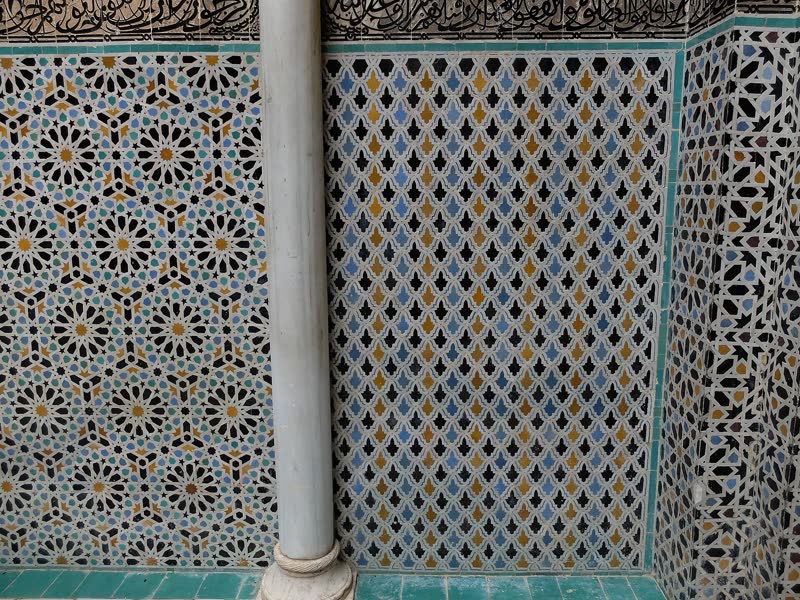
© Robert Prazeres · CC BY-SA 4.0 · Wikimedia Commons
Colour
The palette grew one glaze at a time, as potters learned new recipes. Historians disagree on exact dates, so treat these as broad periods.