The Moroccan mosaic
الزليج
A journey from the wall down to the smallest hand-cut piece, and back through ten centuries.
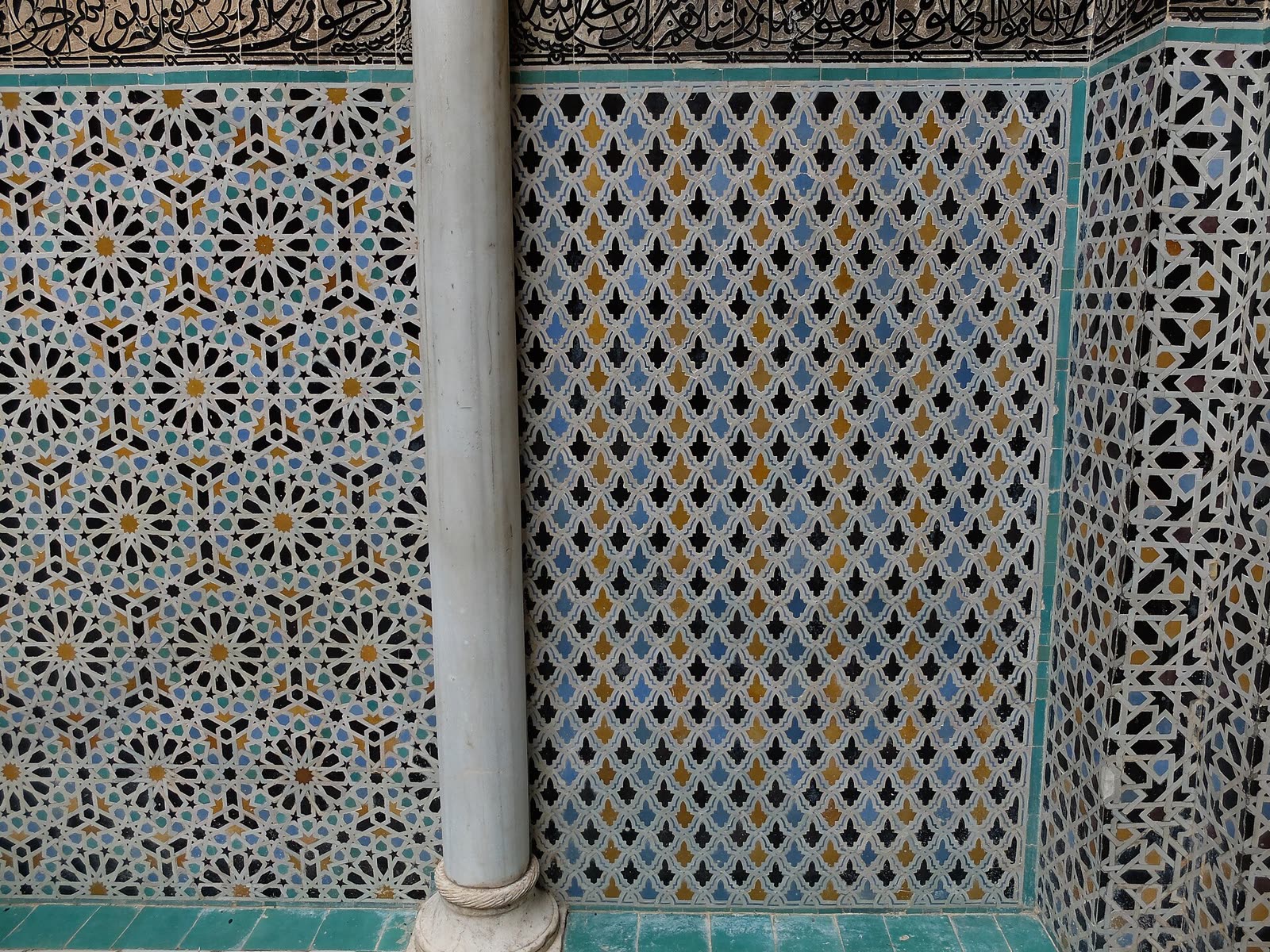
01 The wall
From a distance it reads as one surface. Up close, it is made of thousands of separate pieces of glazed clay.
02 The rosette
Sixteen-fold symmetry, all of it measured out with a compass and a straightedge before any clay is cut.
03 Anatomy
Every ring is a family of identical shapes. The cutter learns each one by hand and by name.
04 The piece
About nine centimetres long. It has a skin of glass, a body of fired earth and edges cut at an angle.
05 Earth
Grey clay from the hills around Fez is soaked, trodden and pressed into squares that dry slowly in the sun.
06 Fire
The tile is fired, glazed with mineral oxides and fired again, until its surface turns to glass.
07 Cut
The cutter traces the shape from a template and chips it free with a sharpened hammer. Each edge is bevelled so the pieces lock together.
08 Assembly
The maâlem lays every piece upside down and builds the pattern from memory without seeing it. Then mortar is poured over the back.
09 Reveal
10 History
Behind the wall are ten centuries of dynasties, cities and workshops.
11 A living heritage
For ten centuries, Moroccan maâlems have cut the same geometry from clay and fire. In the workshops of Fez and Tétouan, they still do. In November 2025, Morocco began the process of inscribing this art on UNESCO’s Representative List of the Intangible Cultural Heritage of Humanity.
I 1040 – 1147
The Saharan dynasty that founded Marrakech. The craft’s own tradition credits it with bringing tile mosaic to Morocco.
Marrakech
II 1121 – 1269
Bands of green and white set high on the minarets: the earliest Moroccan zellij that can be reliably dated.
Kutubiyya Mosque, Marrakech
III 1244 – 1465
The golden age. Fez fills with madrasas, the palette widens and the stars multiply into dense fields.
Bou Inania & al-Attarine madrasas, Fez
IV 1549 – 1659
Pieces cut finer than ever, with thin coloured strapwork running across white grounds.
Saadian Tombs, Marrakech
V 1666 →
Zellij leaves the palace for city gates, public fountains and family homes.
Bab al-Mansur, Meknes
VI Today
Still cut by hand, piece by piece, in the workshops of Fez and Tétouan.
Hassan II Mosque, Casablanca