Daily life

Not kept in museums.
Lived with.

الزليج في الحياة اليومية

In Morocco, zellij is part of ordinary places: the wall you lean on, the floor of a courtyard, the fountain at the corner of the street. It is meant to be touched, washed and walked past every day.

8 places~10 min read

From the 14th century on, zellij was used wherever durability mattered: the lower walls of rooms, fountains and pools, floors, minarets and doorways. The reasons were practical before they were decorative.

Glazed tile is waterproof and hard-wearing, and it can be washed. It stays cool in the summer heat. It protects lime plaster where people's hands, shoulders and furniture rub against the wall. These qualities explain where zellij appears in a Moroccan building. The geometry is what makes those surfaces beautiful.

Here are eight places to find it, from the grandest buildings to the most everyday.

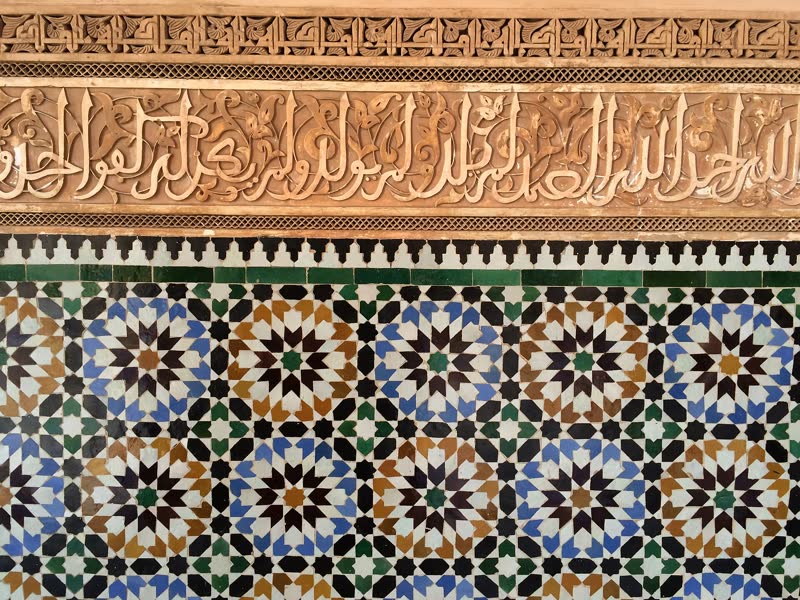
Zellij beneath a band of carved stucco calligraphy, Ben Youssef Madrasa, Marrakech
The classic order: zellij below, carved stucco above. Ben Youssef Madrasa, Marrakech.

© Elena Tatiana Chis · CC BY-SA 4.0 · Wikimedia Commons

I

Walls

The most common use is the dado, a band of tile along the lower part of a wall, usually up to about shoulder height. Above it comes carved stucco, and above that carved and painted cedar. The Marinid madrasas of the 14th century established this order, and it is still the standard formula of a traditional Moroccan room.

The dado protects the soft plaster where it is most exposed. Visually, it gives the room a solid, glittering base under lighter, more delicate ornament.
II

Riads & houses

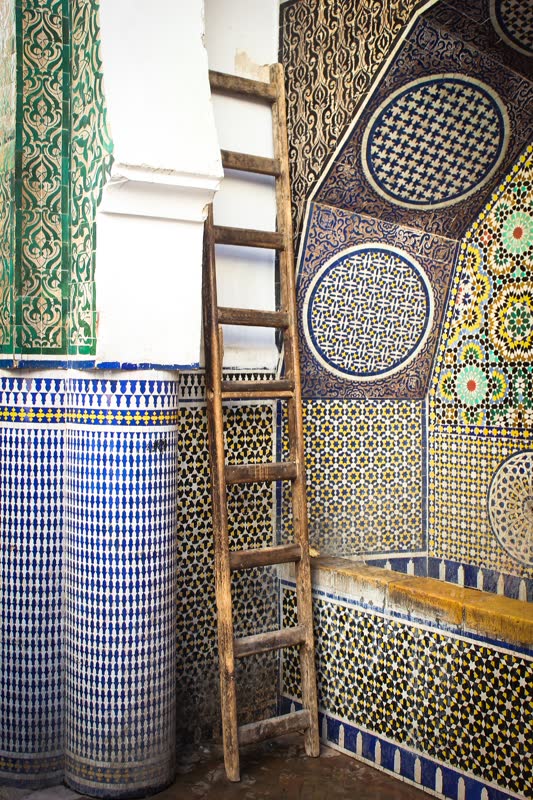
The traditional city house faces inward. Behind a plain door on a narrow street, a passage turns a corner so passers-by cannot see in, then opens onto a courtyard. In a riad, the courtyard is a garden of four planted beds around a central fountain.

The courtyard is where family life happens, so it is where the tile is. Floors are paved in zellij or checkerboard tile, a dado lines the walls, and a tiled basin often stands at the centre. Under an open sky, the glaze reflects light into the rooms around it.

III

Hammams

Every neighbourhood had its public bath, usually close to the mosque and the bakery and sometimes sharing their fires. The hammam is a place for washing, but also for talking, celebrating and visiting before weddings.

Glazed tile does not mind heat or water, so it appears on basins, fountains and the lower walls of many bathhouses and their entrance halls. The hot rooms themselves are often finished in polished lime plaster, tadelakt, so the two materials work side by side.

A tiled wall fountain in the medina of Fez
A tiled wall fountain in the medina of Fez.

© Ritahouari · CC BY-SA 4.0 · Wikimedia Commons

IV

Street fountains

Before running water reached every home, people fetched water from public fountains set into the walls of the medina. Many were endowed as acts of charity. The fountain was a meeting place, and it was often the most decorated thing on the street.

The best-known is the 18th-century Nejjarine Fountain in Fez. Its basin, built for ritual washing before prayer, sits beneath a zellij horseshoe arch with stucco and a carved cedar canopy. Meknes has a 1913 fountain on Place el-Hedim with a large tiled rosette.

V

Mosques & madrasas

Religious buildings were where zellij first developed, first on minarets and then in prayer halls, ablution courts and the courtyards of the madrasas. The art is aniconic: it uses no images of people or animals, only geometry, plant scrolls and calligraphy.

Geometry suits these spaces. A pattern built from a star can in principle continue forever in every direction. It has no centre and no edge, which makes it a natural image of the infinite.

VI

Palaces

In palaces, zellij spreads far beyond the dado. It covers fountains and the paving around them, the spandrels of arches, checkerboard grounds, and sometimes whole pillars up to the capital.

The 19th-century Bahia Palace in Marrakech shows the domestic version at its most generous, with courtyards of marble and zellij and rooms lined with tile below painted cedar ceilings. The Saadian Tombs show the royal version at its most refined.

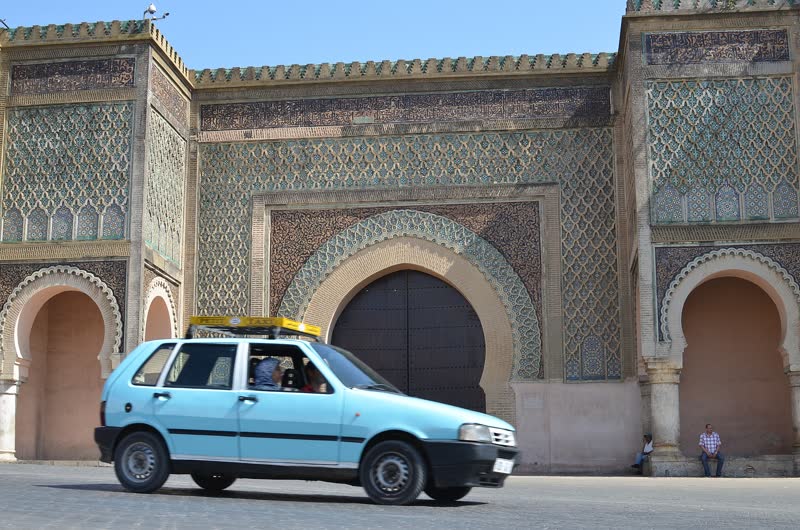
Bab al-Mansur, the monumental gate of Meknes, covered in green tilework
Bab al-Mansur, the great gate of Meknes.

© Steven Lek · CC BY-SA 4.0 · Wikimedia Commons

VII

City gates

A city gate shows off the power of whoever built it. Sultan Moulay Isma'il decorated the gates of imperial Meknes, including Bab al-Mansur, with glazed tile and sgraffito. In Fez, Bab Bou Jeloud (1913) is faced in blue tile on the side facing outward and green on the side facing the medina.

People pass through these gates every day. They are among the most photographed walls in Morocco.

VIII

Today's homes

Zellij has never left the Moroccan home. Today it lines kitchens and bathrooms, the tops of café tables, hotel lobbies, restaurant counters and the lower walls of new apartments, often in single plain colours rather than complex patterns.

It is also used abroad. Architects and designers seek out the uneven, glassy surface of hand-made tile, where no two pieces catch the light the same way. The same quality now makes it a target for cheap imitations. A genuine piece of zellij is cut by hand, and its slight irregularity is the sign of that.

Stars are the idealized shapes among all of God's works.
A zellij master in Fez (Saudi Aramco World, 2001)

Sources & further reading

  1. Zellij, Wikipedia (uses of zellij from the 14th century; el-Hedim fountain; Bab Bou Jeloud)
  2. Bahia Palace, Wikipedia
  3. Fontaine Nejjarine, Fodor's; Funduq al-Najjarin, Archnet
  4. Moroccan architecture, Wikipedia
  5. Louis Werner, “Zillij in Fez”, Saudi Aramco World, 2001