The Craft

Earth, fire
and the hammer

صنعة الزليج

Every piece of zellij passes through the same hands and the same steps. It begins as grey clay from the hills outside Fez and ends as a star in a panel that cannot be seen until it is turned over.

6 steps4 trades~12 min read

In one sentence

Clay is shaped into squares and fired. The squares are glazed in a single colour and fired again, then cut by hand into small shapes. The shapes are laid face-down into a pattern and bound together with mortar.

That is the whole method, and it has changed little in centuries. The difficulty lies in the precision. A single panel can need thousands of pieces in dozens of shapes. Each one is cut with a hammer and fitted to its neighbours with a gap no wider than a line of mortar.

The details below come mainly from the workshops of Fez, the historic centre of the craft. Most of them follow Louis Werner's account of Fez craftsmen for Saudi Aramco World. Methods vary from workshop to workshop and city to city, and Tétouan, for example, cuts its tiles before firing.

The process

Six steps
from hill to wall

01

Earth

The clay comes from Jebel Ben Jelliq, near Fez. It is a fine grey clay, and after firing it can be scored and struck so that it breaks cleanly along a straight line. That property is the reason the craft is centred on Fez.

The clay is soaked until soft and worked by hand and foot. It is then pressed into square tiles, traditionally about 10 centimetres on each side, and left to dry slowly in the sun. Drying too fast causes cracks.

10 cm the “mother tile”grey Fez clay
02

Fire

The tiles are fired in beehive-shaped kilns with two levels. Traditionally the fuel is faytour, olive pomace: the pits and dry pulp left after the olives are pressed. It burns extremely hot, and Morocco has plenty of it.

The first firing, in the hotter lower chamber, turns the clay into biscuit. Heat moves unevenly through a wood- or pomace-fired kiln, which is one reason no two tiles come out exactly alike.

2 firingsfaytour olive pomace
03

Glaze

One face of each tile is dipped in a single colour. Historically the glaze was lead-based. In 2001 Werner described a mixture of sandy red soil from Meknes and lead, baked in the kiln for two days, then milled and mixed with water and pigment.

The colours come from metal oxides. Copper gives green, and cobalt and manganese ores give deep blue and black. Some colours, such as turquoise, rose and yellow, were by then often imported. A second firing in the cooler upper chamber of the kiln turns the coating into glass.

copper greencobalt bluemanganese brown–black
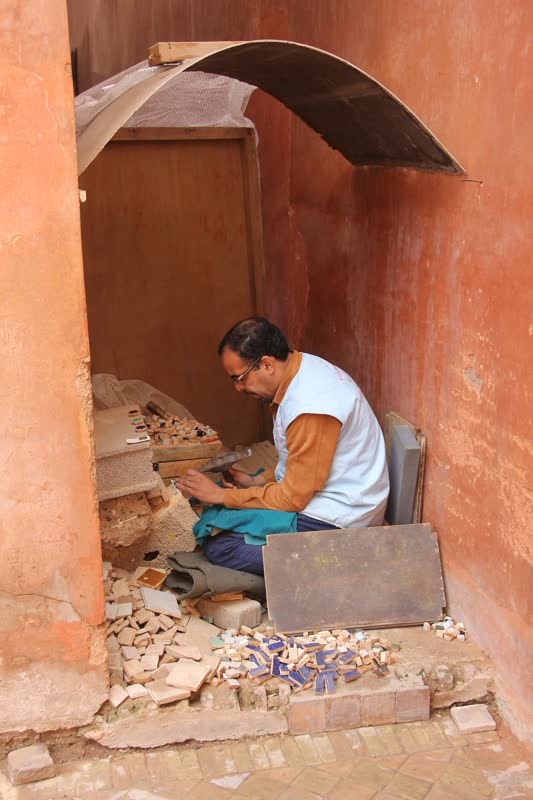
A craftsman cutting zellij pieces by hand in Marrakech
A craftsman cutting pieces for the restoration of the Saadian Tombs, Marrakech.

© Elgaard · CC BY-SA 4.0 · Wikimedia Commons

04

Cut

Cutting gives zellij its name. The cutter, the nqaash, draws the outline of a shape on the glazed tile using a template. He then chips it free with a sharpened, chisel-headed hammer, often called a menqach, working against a steel-tongued anvil.

A finisher then bevels the back of every piece, so the glazed face is slightly larger than the base. This lets the pieces sit tight at the surface and leaves room underneath for mortar. A cutter can produce several hundred simple shapes a day. For the most delicate strapwork, eighty pieces is a good day.

One scholar counted around 360 named shapes, called furmah, in the Fez repertoire. Some names are geometric and some are taken from everyday life, such as “ducks” and “combs”. The smallest piece, the qamarshun, is about one centimetre long.

~360 shapes1 cm the smallest80 fine pieces / day
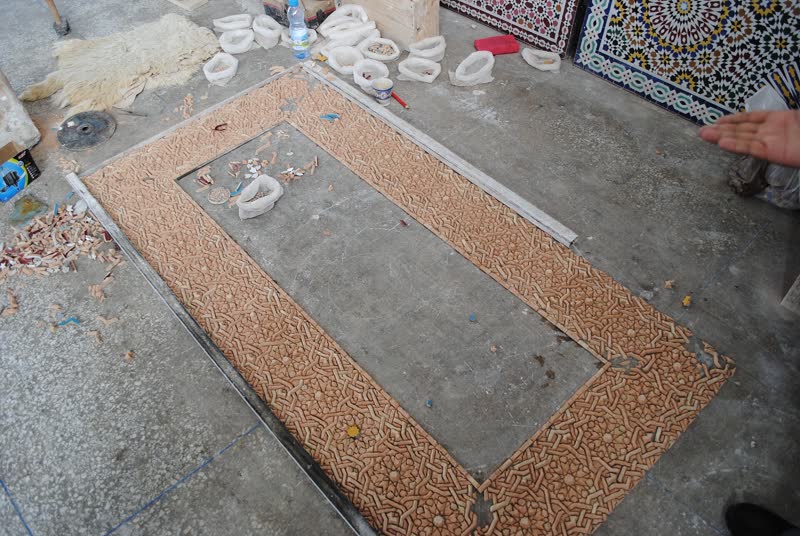
A zellij panel being assembled face-down on the workshop floor in Fez
A panel laid face-down on a workshop floor in Fez. Plaster will be poured over the back.

© Jadcooper · CC BY-SA 4.0 · Wikimedia Commons

05

Lay

The layout artist, the fraash, builds the pattern face-down on the workshop floor. He sees only the unglazed backs of the pieces and works from memory and from the shapes themselves.

He usually begins with the small eight-pointed stars, called dirhams after the coin, and works outward one colour at a time. A single 24-point star panel recorded in Fez needed about 5,000 pieces in 32 shapes and 8 colours.

When the layout is complete, mortar is spread over the back. Traditionally this was plaster or lime; today it is often cement with a concrete backing. The mortar fills every bevelled joint and binds the panel into one slab.

5,000 pieces32 shapes8 colours
06

Set

Only when the mortar has set is the panel lifted and turned over. Only then does anyone, the maker included, see the pattern face-up for the first time.

The finished panels are carried to the building and fixed to the wall, floor or fountain by the master mosaicist, the zlayji. He fills the last joints and fits the edges and corners by hand on site.

face-up at last

The workshop

Four trades,
one panel

A large commission passes through several specialists. In family workshops one person may do several of these jobs. Masters are known by the title maâlem.

الفخار

The potter

Prepares the clay, shapes the tiles, runs the kiln and applies the glaze.

النقاش

Nqaash

The cutter. He traces the template and chips out the shapes with hammer and anvil.

الفراش

Fraash

The layout artist. He lays the pattern face-down, piece by piece and colour by colour.

الزلايجي

Zlayji

The master mosaicist. He designs the work and installs the finished panels on site.

Truthfulness, sidq, is in everything I make.
A Benslimane master, from a family of zellij makers in Fez spanning five generations (Saudi Aramco World, 2001)

Learning the trade

The craft is still passed on mainly within families and workshops. Apprentices often start young; one of the masters interviewed in Fez began at thirteen. They learn the shapes by repetition until the hand knows them without a template. Master craftsmen now worry that fewer young people want to spend years learning a trade that machine-cut imitations can undercut.

Variations

Taqshir (“peeled work”): instead of cutting shapes apart, the glaze is scraped away to leave a pattern in low relief. Sgraffito: a related technique, carving through a glaze layer, used on minarets and gates since the Marinid period. Tétouan: tiles are cut before firing, which gives a harder glaze but softer colours and looser joints.

Glossary

Words of
the workshop

Zellij زليج
Mosaic of hand-cut glazed tile pieces. Also spelled zellige or zillij.
Maâlem معلم
A master craftsman, in any trade.
Zlayji
The master mosaicist who designs and installs zellij.
Nqaash
The tile cutter.
Fraash
The layout artist who sets the pieces face-down.
Menqach
The sharpened, chisel-headed hammer used to cut the pieces.
Furmah
A named cut shape. The Fez repertoire runs to several hundred.
Dirham
A small eight-pointed star piece, named after the coin.
Qamarshun
One of the smallest pieces, about 1 cm long.
Faytour
Olive pomace, the traditional kiln fuel.
Taqshir
“Peeled work”: glaze scraped away to leave a pattern in relief.
Alicatado
The Spanish name for cut-tile mosaic, from Arabic qaṭaʿa, “to cut”.

Sources & further reading

Figures such as daily output and piece counts come from interviews with Fez craftsmen and will vary between workshops.

  1. Louis Werner, “Zillij in Fez”, Saudi Aramco World, May/June 2001
  2. Zellij, Wikipedia (technique, Tétouan method, mortar)
  3. R. Choksey, An Ethnographic Study of Zellige Craftsmen, WPI
  4. CeROArt (2024), article on Moroccan zellige
  5. “Watch Intricate Moroccan Tile Mosaics Shaped by Hand”, Make
  6. “As machines move in…”, Le360